
For many company directors, one of the most common questions at the start of a new tax year is:
Should I pay myself a salary, dividends, or a combination of both?
There is no single answer that suits every business. The most tax-efficient way to extract profits depends on several factors, including your company’s profitability, personal tax position, National Insurance, future investment plans, and long-term financial goals.
With several important tax changes taking effect for the 2025/26 tax year, now is the ideal time to review your remuneration strategy and ensure you are paying yourself in the most effective way.
Tax Changes Directors Should Know About
The 2025/26 tax year introduces several changes that may affect owner-managed businesses and company directors.
Additional Dividend Reporting
If you are both a company director and shareholder, HMRC is introducing additional reporting requirements through the Self Assessment process.
Directors receiving dividends from their own companies will be required to provide more detailed information regarding those dividend payments and their shareholding.
The purpose of these changes is to improve transparency and help HMRC better understand the relationship between company ownership and personal income.
Although the reporting process becomes more detailed, it does not necessarily mean you will pay more tax. It simply means that accurate record keeping has become even more important.
Additional Self-Employment Reporting
HMRC is also introducing additional reporting requirements for self-employed individuals.
Where applicable, taxpayers will need to provide details about when a self-employed business started or ceased trading as part of their Self Assessment return.
These additional disclosures are intended to improve HMRC’s understanding of trading activities and employment status.
Changes to Employer National Insurance
One of the biggest changes affecting businesses during the 2025/26 tax year is the increase in Employer National Insurance costs.
From April 2025:
- The Employer National Insurance rate increased from 13.8% to 15%.
- The Secondary Threshold reduced from £9,100 to £5,000 per year.
This means many employers will begin paying Employer National Insurance sooner and at a higher rate than before.
However, there is positive news for eligible businesses.
The Employment Allowance has increased from £5,000 to £10,500, allowing many employers to reduce their Employer National Insurance bill.
It is important to note that companies where the only employee paid above the Employer National Insurance Secondary Threshold is a director are generally not eligible to claim the Employment Allowance. Businesses with additional qualifying employees may be able to benefit, provided they meet HMRC’s eligibility conditions.
If you operate more than one connected company, the Employment Allowance can generally only be claimed once across the group.
Salary or Dividends – What’s the Difference?
Both salaries and dividends are legitimate ways for company directors to receive income, but they are taxed differently and each has its own advantages.
Rather than asking which method is “better,” it is more useful to understand when each option may be appropriate.
Paying Yourself a Salary
A salary is processed through the company’s payroll under the PAYE system.
Advantages of Taking a Salary
- Provides a regular and predictable monthly income.
- Counts as earned income for mortgage and loan applications.
- Helps build qualifying years for the State Pension, subject to National Insurance thresholds.
- Salary and employer’s National Insurance are generally deductible business expenses for Corporation Tax purposes.
- Can support pension contributions and employee benefits.
Disadvantages of Taking a Salary
- Subject to Income Tax.
- Employee National Insurance may apply.
- Employer National Insurance may also be payable.
- Increases monthly payroll administration.
Paying Yourself Through Dividends
Dividends are payments made from a company’s profits after Corporation Tax has been paid.
Unlike salaries, dividends can only be paid when the company has sufficient distributable profits.
Advantages of Dividends
- No Employee or Employer National Insurance contributions.
- Dividend tax rates are generally lower than Income Tax rates on employment income.
- Greater flexibility over when payments are made.
- No PAYE deductions.
Disadvantages of Dividends
- Can only be paid if sufficient profits are available.
- Do not reduce the company’s Corporation Tax liability.
- Income can be less predictable.
- Proper dividend paperwork and board minutes should always be prepared.
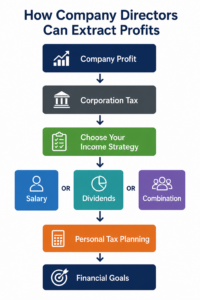
Which Option Is More Tax Efficient?
Many directors naturally ask which option leaves them with the highest take-home income.
The answer depends on your individual circumstances.
Factors that influence the most tax-efficient strategy include:
- Company profits.
- Corporation Tax.
- Personal tax bands.
- National Insurance thresholds.
- Employment Allowance eligibility.
- Pension contributions.
- Other personal income.
- Future investment plans.
- Mortgage requirements.
For many owner-managed companies, a carefully planned combination of salary and dividends often provides the best balance between tax efficiency, regular income and flexibility.
However, this should always be reviewed each tax year as tax legislation changes regularly.
Don’t Forget the Dividend Allowance
For the 2025/26 tax year, the Dividend Allowance remains at £500.
Any dividends received above this allowance may be subject to Dividend Tax depending on your overall taxable income.
Planning dividend payments carefully throughout the year can help reduce unnecessary tax liabilities.
Common Mistakes Directors Should Avoid
When deciding how to pay yourself, there are several common mistakes to avoid.
Paying Dividends Without Profits
A company must have sufficient distributable profits before declaring dividends.
Paying dividends when profits are unavailable may result in the payment being treated as a Director’s Loan, which can have tax consequences if not dealt with correctly.
Ignoring Employer National Insurance
Many directors focus only on Income Tax while overlooking the increased Employer National Insurance costs introduced in April 2025.
Considering the overall tax position usually provides a more accurate picture.
Never Reviewing Your Strategy
A remuneration strategy that worked well last year may no longer be the most efficient this year.
Tax rates, thresholds and business profits change regularly, so it is worth reviewing your position annually.
Four Tips for Planning Ahead
To make the most of your remuneration strategy, consider the following:
- Forecast your company’s expected profits for the year.
- Review the most appropriate salary level based on current tax and National Insurance thresholds.
- Plan dividend payments carefully to balance personal income requirements with business cash flow.
- Review your remuneration strategy throughout the year rather than waiting until the year end.
Regular planning allows you to respond to changes in profitability and tax legislation before they become costly.
How Business Management Consultation Can Help
Every business is different, and there is rarely a one-size-fits-all solution.
At Business Management Consultation, we help company directors choose the most appropriate remuneration strategy based on their individual circumstances.
Our services include:
- Director remuneration planning.
- Corporation Tax planning.
- Payroll and PAYE services.
- Dividend planning.
- Annual accounts preparation.
- Bookkeeping.
- Self Assessment Tax Returns.
- Business tax advice.
Whether you are a new company director or have been running a business for many years, we can help ensure you are paying yourself efficiently while remaining fully compliant with HMRC requirements.
Conclusion
Choosing between salary, dividends or a combination of both is one of the most important financial decisions a company director makes each year.
While dividends may offer tax advantages in certain circumstances, salaries provide stability, pension benefits and can support future borrowing.
For many owner-managed businesses, the most effective approach is often a carefully planned combination of both.
Because every business is different, taking professional advice can help you minimise tax, maximise efficiency and avoid costly mistakes.
If you would like personalised advice on the most tax-efficient way to pay yourself, Business Management Consultation is here to help.
Call us on 01273 777 333 or contact our team today to discuss your director remuneration strategy.






Leave a comment