
Every business experiences challenges at some stage of its lifecycle. While some companies face temporary financial difficulties, others reach a point where the owners decide it is time to retire, move on to a new venture or simply close the business.
Understanding your options at the earliest opportunity can make a significant difference to the outcome. Whether your priority is recovering your business or bringing it to an orderly and tax-efficient close, professional advice can help you make informed decisions while protecting your financial interests.
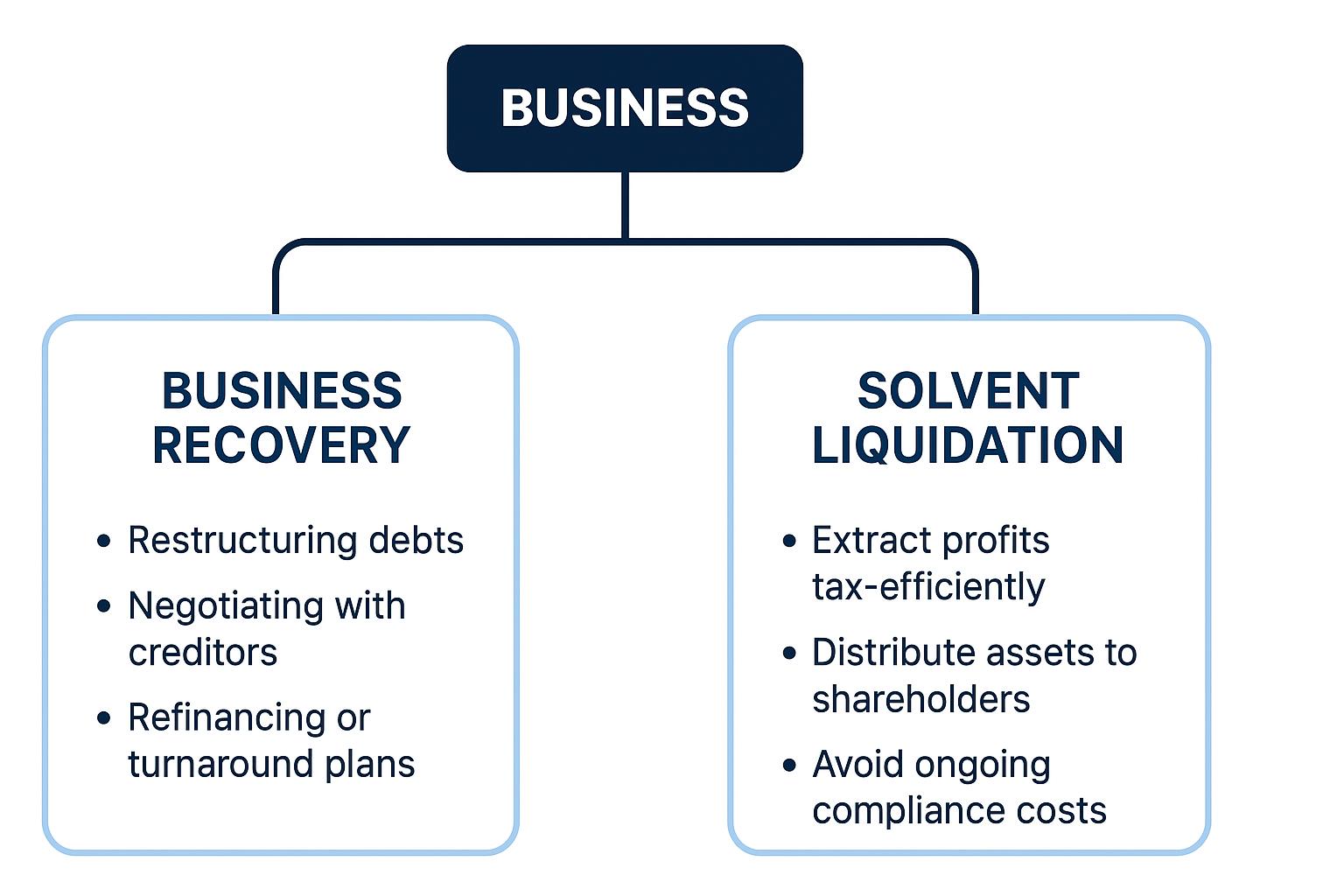
What Is Business Recovery?
Business recovery is the process of helping a financially distressed but potentially viable business return to stability.
Rather than immediately considering insolvency, recovery focuses on identifying practical solutions that improve the company’s financial position and support its long-term future.
Depending on the circumstances, business recovery may involve:
- Improving cash flow.
- Restructuring debts.
- Reducing operating costs.
- Refinancing existing borrowing.
- Negotiating with creditors.
- Reviewing pricing and profitability.
- Implementing operational improvements.
Seeking advice early can often improve the chances of recovery and, in some cases, help businesses avoid formal insolvency procedures.
When Should You Consider Business Recovery?
Warning signs that may indicate your business needs professional support include:
- Persistent cash flow problems.
- Difficulty paying suppliers on time.
- Increasing pressure from creditors.
- Falling profits.
- Growing tax liabilities.
- Difficulty meeting loan repayments.
- Reduced working capital.
Recognising these issues early gives directors more options and increases the likelihood of achieving a successful turnaround.
What Is a Members’ Voluntary Liquidation (MVL)?
A Members’ Voluntary Liquidation (MVL) is a formal process used to close a solvent company.
An MVL is only available where the directors believe the company can pay all of its debts, together with any statutory interest, within 12 months of the liquidation commencing.
The process is carried out by a licensed insolvency practitioner, who realises the company’s assets, settles outstanding liabilities and distributes the remaining funds to shareholders in accordance with insolvency legislation.
Why Choose an MVL?
An MVL is commonly used where:
- The directors are retiring.
- The business has ceased trading.
- A group structure is being simplified.
- The company is no longer required.
- Shareholders wish to extract retained profits in a tax-efficient manner.
Distributions made during an MVL are generally treated as capital distributions rather than income. Depending on the shareholder’s individual circumstances and whether the qualifying conditions are met, Business Asset Disposal Relief (BADR) may reduce the Capital Gains Tax payable.
Professional tax advice should always be obtained before proceeding, as the tax treatment will depend on your specific circumstances.
Business Recovery vs MVL
| Business Recovery | Members’ Voluntary Liquidation |
|---|---|
| Suitable for viable businesses experiencing financial difficulties | Suitable for solvent companies that wish to close |
| Focuses on improving cash flow and returning the business to stability | Brings the company to an orderly and formal end |
| May involve restructuring, refinancing or creditor negotiations | Assets are realised and distributed after liabilities are settled |
| Aims to preserve the business where possible | Aims to return value to shareholders efficiently |
How Business Management Consultation Can Help
At Business Management Consultation, we work with business owners to understand their objectives before recommending the most appropriate course of action.
Our services include:
- Business recovery advice.
- Cash flow and financial reviews.
- Business restructuring support.
- Exit planning.
- Tax planning.
- Liaison with licensed insolvency practitioners where an MVL is appropriate.
- Business advisory services.
Whether your goal is to rescue your business or bring it to a successful conclusion, we can help you understand your options and guide you through each stage of the process.
Conclusion
Every business is different, and there is no one-size-fits-all solution when financial challenges or exit decisions arise.
Early advice can often provide more options, reduce financial risk and help you achieve the best possible outcome. Whether your business is experiencing temporary difficulties or you are planning a tax-efficient exit through a Members’ Voluntary Liquidation, careful planning is essential.
If you are considering your next steps, professional advice can help you make informed decisions while protecting both your business and your personal wealth.
Call us today on 01273 777 333 to discuss your business recovery or exit planning options.






Leave a comment