
Accounting is the backbone of every successful business, providing the financial information needed to make informed decisions, monitor performance, and achieve long-term growth. Whether you are a sole trader, partnership, charity, or limited company, maintaining accurate financial records is essential for understanding how your business is performing and ensuring compliance with legal and tax obligations.
Often referred to as the “language of business,” accounting translates everyday financial transactions into meaningful reports that help business owners, investors, lenders, and other stakeholders assess the financial health of an organisation. By recording income, expenses, assets, liabilities, and equity, accounting creates a clear picture of where a business stands and where it is heading.
Why Accounting Matters
A well-maintained accounting system provides numerous benefits, including:
- Monitoring profitability and business performance.
- Managing cash flow effectively.
- Preparing accurate tax returns and statutory accounts.
- Supporting budgeting and financial forecasting.
- Identifying opportunities to reduce costs and improve efficiency.
- Assisting with securing finance from banks and investors.
- Meeting legal and regulatory requirements.
Without reliable accounting records, businesses may struggle to identify financial problems until they become serious, potentially leading to cash flow issues, unexpected tax liabilities, or poor strategic decisions.
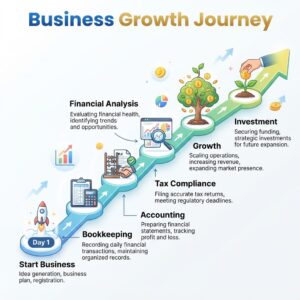
The Main Areas of Accounting
Financial Accounting
Financial accounting focuses on preparing annual financial statements such as the Profit and Loss Account, Balance Sheet, and Cash Flow Statement. These reports provide external stakeholders with an overview of the company’s financial position and performance.
Management Accounting
Management accounting provides internal reports that help business owners and managers make strategic decisions. This includes budgeting, forecasting, cost analysis, performance reporting, and profitability analysis.
Tax Accounting
Tax accounting ensures businesses meet their obligations to HM Revenue & Customs (HMRC). It involves preparing Corporation Tax, Self Assessment Tax Returns, VAT Returns, PAYE, National Insurance calculations, and advising on legitimate tax planning opportunities.
Bookkeeping
Bookkeeping forms the foundation of accounting by recording every financial transaction accurately and consistently. Good bookkeeping ensures financial reports are reliable and up to date.
The Accounting Equation
Every accounting system is based on a simple but fundamental equation:
Assets = Liabilities + Owner’s Equity
This equation ensures every financial transaction remains balanced and accurately reflects the financial position of the business.
For example:
- Purchasing equipment increases assets.
- Taking out a loan increases both assets and liabilities.
- Making a profit increases owner’s equity.
Key Financial Statements
Profit and Loss Account
Shows the income earned and expenses incurred during a financial period, resulting in either a profit or a loss.
Balance Sheet
Provides a snapshot of what the business owns (assets), owes (liabilities), and the owner’s investment (equity) at a specific date.
Cash Flow Statement
Tracks how cash moves into and out of the business through operating, investing, and financing activities.
Accounting Supports Better Decision-Making
Accurate accounting enables businesses to answer important questions such as:
- Is the business making a profit?
- Can we afford to expand?
- Are overhead costs increasing?
- Do customers pay on time?
- Is there enough cash available to meet upcoming liabilities?
- Which products or services generate the highest profits?
Reliable financial information allows business owners to make decisions based on facts rather than assumptions.
Modern Accounting Technology
Cloud accounting software has transformed the way businesses manage their finances. Features such as automated bank feeds, digital invoicing, expense tracking, payroll integration, VAT submissions, and real-time reporting save time while improving accuracy.
Automation reduces manual data entry and allows accountants to focus on providing valuable business advice rather than simply processing numbers.
The Role of Professional Accountants
Professional accountants do far more than prepare annual accounts. They help businesses:
- Stay compliant with HMRC and Companies House requirements.
- Improve profitability through financial analysis.
- Plan for growth and investment.
- Manage business risks.
- Prepare budgets and forecasts.
- Navigate complex tax legislation.
- Support business sales, acquisitions, and succession planning.
A trusted accountant acts as a financial adviser who helps businesses make confident and informed decisions throughout every stage of their journey.
Conclusion
Accounting is far more than recording numbers—it is the language that communicates the financial story of a business. Accurate accounting provides clarity, supports informed decision-making, ensures legal compliance, and lays the foundation for sustainable growth. Whether you are starting a new venture or managing an established organisation, investing in good accounting practices is one of the most valuable decisions you can make for the future of your business.




Leave a comment